Intrusion Detection & Response (IDR)
At a Glance
What Is Intrusion Detection & Response?
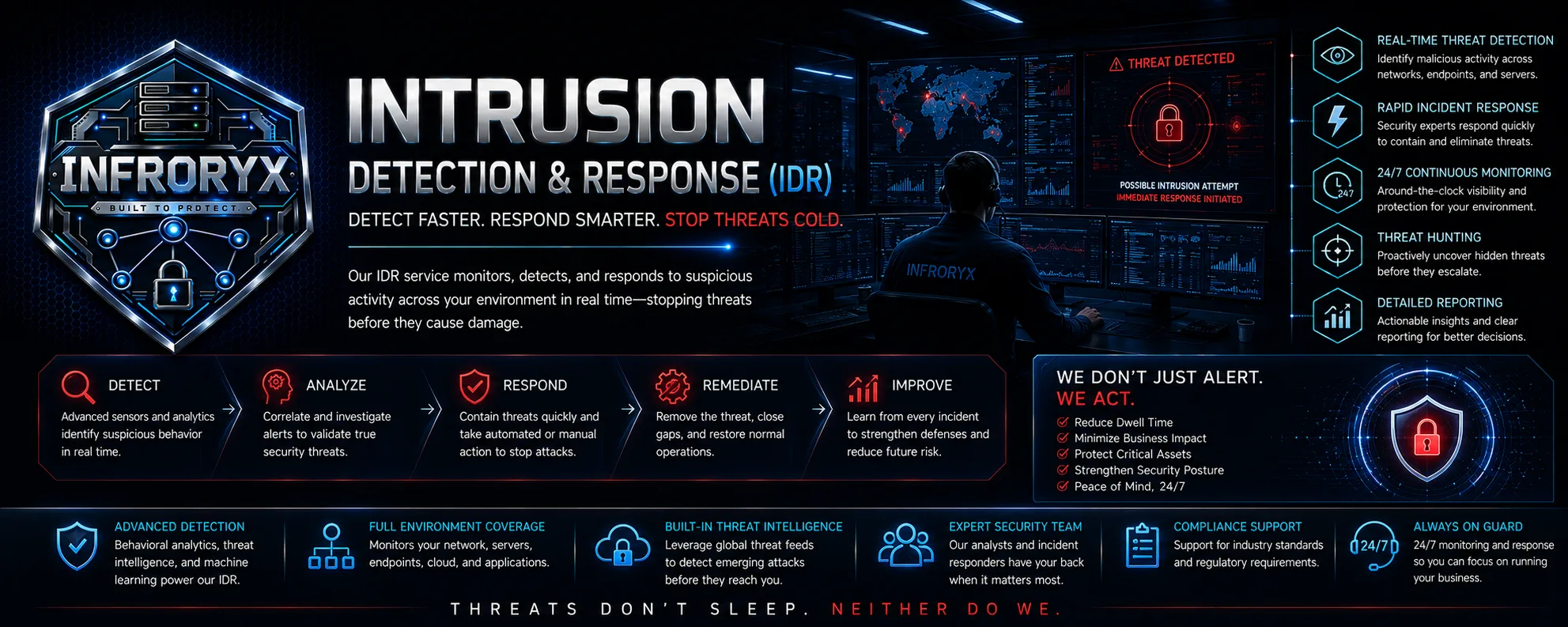
Our IDR solution (also known as SIEM) actively monitors your network 24/7 for early signs of attack. It combines three layers: automated threat detection, skilled security experts who review every alarm, and remediation that happens in near real time — without interrupting your business.
“Attackers don’t work business hours. Neither does your detection.”
We Don’t Just Alert. We Act.
The IDR Lifecycle
Detect
Advanced sensors and analytics identify suspicious behavior in real time.
Analyze
Alerts correlated and investigated to validate true security threats.
Respond
Threats contained quickly with automated or manual action to stop attacks.
Remediate
The threat removed, gaps closed, and normal operations restored.
Improve
Every incident strengthens defenses and reduces future risk.
The Three Layers
Automation provides the reach — watching everything, all the time, at machine speed. Human experts provide the judgment — separating real threats from noise so you’re not drowning in false alarms. Response provides the outcome — containment and remediation while the attack is still small.
Why Centralized Logging Matters
A SIEM collects and correlates logs from across your environment — network, servers, identities, and cloud. That’s what turns scattered events into a visible attack pattern, provides the evidence trail investigations and audits require, and satisfies the log-retention expectations of common compliance frameworks.
What We Watch For
The early moves attackers make: unusual login patterns, privilege changes, lateral movement between systems, unexpected data flows, and configuration anomalies. Catching these opening moves is the difference between an incident report and a headline.
Detection That Ends in Action
Alerts without response are just anxiety. Every detection flows into a defined response path — verified, contained, remediated, and reviewed — so threats are actually stopped, not just observed.
FAQ
Good Questions
What’s the difference between SIEM and IDR?
The SIEM is the engine — centralized logging, correlation, and detection. IDR is the full service: the engine plus 24/7 expert review and near real-time response.
Do we see what’s happening?
Yes. You get visibility into detections and actions taken, with reporting at a cadence that fits how your organization operates.
Does this satisfy compliance logging requirements?
Centralized log collection and retention support the expectations of common frameworks — and provide the evidence trail auditors and insurers ask about.
Related
It All Works Better Together
Ready to close this gap? Let’s talk.
Every engagement starts with a free conversation about your environment and your risks — no prepackaged bundles, no obligation.