Penetration Testing
At a Glance
What Is Penetration Testing?
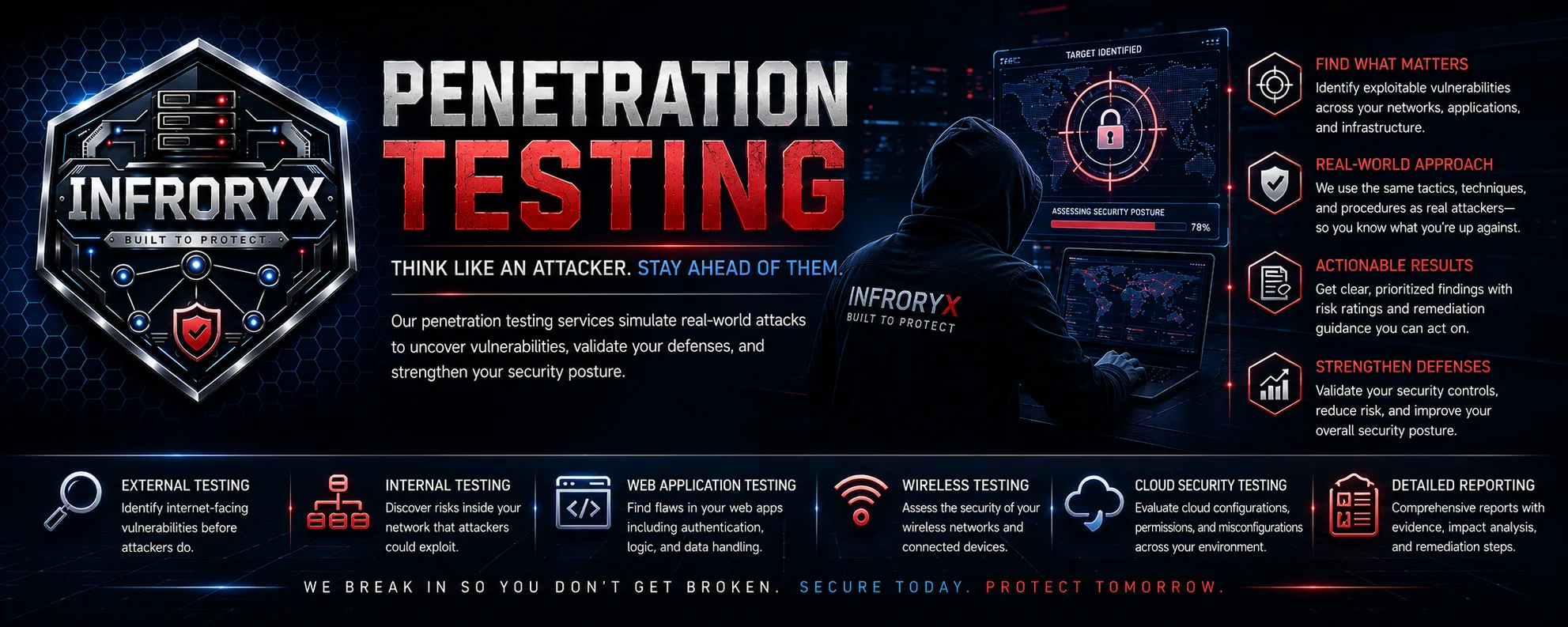
To outfox cyberattackers, you need to know how they think — and how they make their attacks. Penetration testing from Infroryx safely identifies your security gaps long before the wrong people find them.
Where scanning lists possible weaknesses, a penetration test proves what an actual attacker could accomplish with them — which doors open, and what’s behind them.
“The best time to discover your weaknesses is when the person exploiting them is on your side.”
We Break In So You Don’t Get Broken
What We Test
How a Test Works
It starts with scope and rules of engagement: what’s being tested, what’s off-limits, and when. Testers then work the way adversaries do — reconnaissance, probing, and controlled exploitation — documenting every step. The result is a factual narrative of what was reachable, not speculation.
What Gets Tested
Whatever your risk profile calls for: external exposure (what the internet can reach), internal networks (what an intruder or rogue device could do inside), applications, and — where scoped — the human layer through social engineering. Each engagement is shaped to your environment.
What You Receive
A clear report: findings ranked by severity and real-world exploitability, the path the testers took, and concrete remediation guidance. Leadership gets the summary; your technical team gets the details; and fixes can be verified once applied.
Pen Testing vs. Vulnerability Scanning
They answer different questions. Scanning asks “what weaknesses exist?” — broad, automated, continuous. Penetration testing asks “what could an attacker actually do?” — deep, human, and point-in-time. Mature programs cycle both.
FAQ
Good Questions
Is testing safe for production systems?
Yes — that’s what rules of engagement are for. Scope, timing, and boundaries are agreed up front, and testing is controlled so business operations aren’t put at risk.
How often should we test?
Commonly once a year, and after significant changes — new infrastructure, major applications, mergers, or shifts in how you operate.
We already scan for vulnerabilities — why test?
Scans enumerate possible weaknesses; a pen test proves which ones matter by chaining them the way a real attacker would. Each strengthens the other.
Related
It All Works Better Together
Ready to close this gap? Let’s talk.
Every engagement starts with a free conversation about your environment and your risks — no prepackaged bundles, no obligation.