
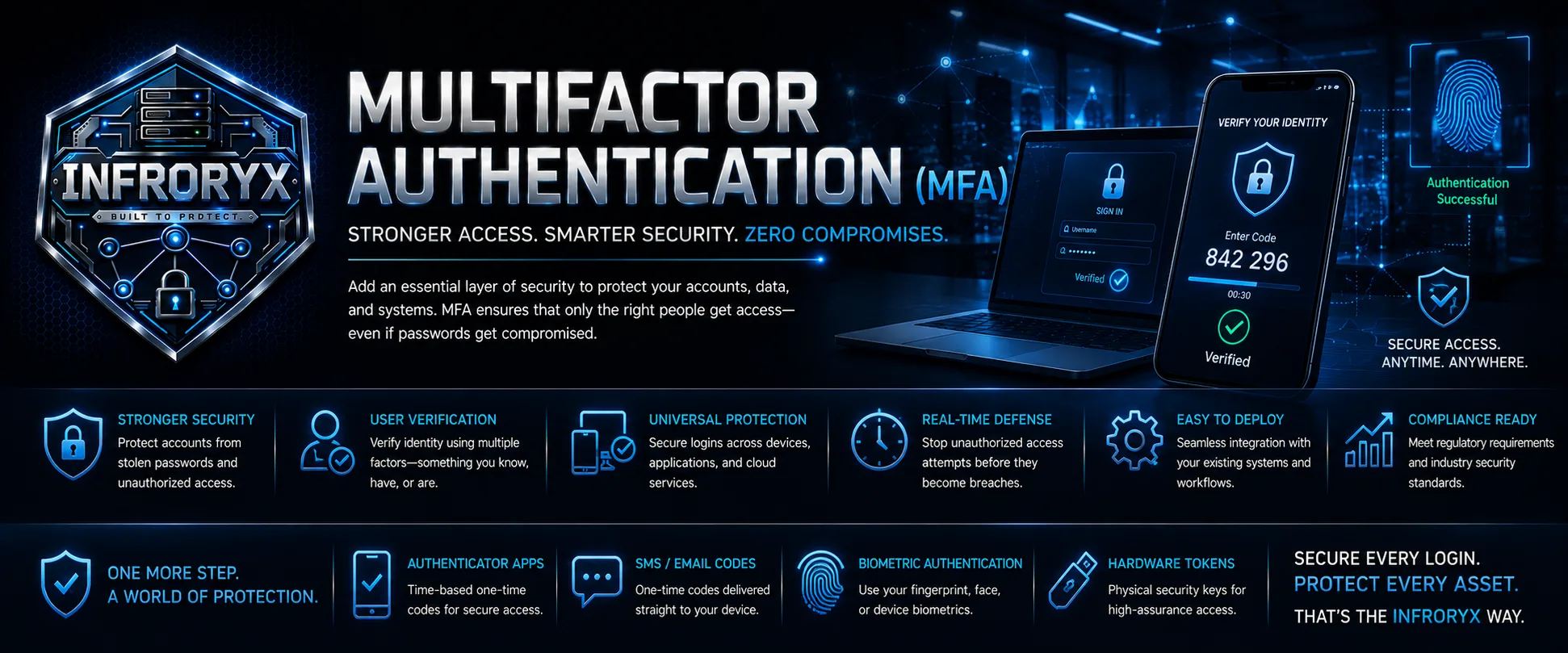
Multifactor Authentication (MFA)
At a Glance
What Is Multifactor Authentication?
Passwords alone are no longer enough to protect your company against cyberattacks and data breaches. MFA adds a second proof of identity — something you have or something you are — so only verified users can access your business applications and services.
Even if a password is phished, guessed, or bought on the dark web, the login fails without the second factor.
“One stolen password shouldn’t be enough to breach your business.”
Ways to Verify
One More Step. A World of Protection.
Why Passwords Fail
People reuse passwords across services, attackers phish them daily, and breached databases circulate for years. Any security model that depends on passwords staying secret is betting against reality.
MFA breaks that dependency: the stolen password stops being a key and becomes just a string.
Where MFA Belongs
Everywhere that matters: email (the gateway to everything else), remote access and VPN, administrative accounts, finance and payroll systems, and your cloud applications. We prioritize coverage by risk so the most valuable doors get locked first.
Deployment Without the Headache
MFA projects fail on user friction, not technology. We plan the rollout, enroll users in waves, tune policies so prompts appear when they should (and not constantly), handle exceptions and legacy systems, and support your team through the change — so adoption sticks.
MFA, Compliance, and Insurance
MFA has become a baseline expectation in compliance frameworks and cyber-insurance questionnaires alike. We implement it properly and document it accurately — so the checkbox reflects a control that genuinely works.
FAQ
Good Questions
Will MFA annoy our employees?
Modern MFA is a one-tap approval, and policies are tuned so prompts appear when risk warrants it — not on every click. Most teams stop noticing it within a week.
Does MFA stop phishing?
It dramatically raises the bar — a phished password alone is no longer enough. Pair it with phishing prevention training and email security for defense in depth.
What about systems that don’t support MFA?
We assess them and design alternatives — network controls, access restrictions, or upgrade paths — so legacy systems don’t stay open doors.
Related
It All Works Better Together
Ready to close this gap? Let’s talk.
Every engagement starts with a free conversation about your environment and your risks — no prepackaged bundles, no obligation.