
Phishing Prevention Training
At a Glance
Why Train for Phishing?
Most security incidents start with a phishing attack aimed at employees — not an exotic technical exploit. One convincing email to one busy person can open the door to credential theft, fraud, or ransomware.
Technology filters catch much of it. Training exists for the messages that get through — because some always do.
“Most incidents start with one convincing email. Training changes how that story ends.”
Educate. Empower. Protect.
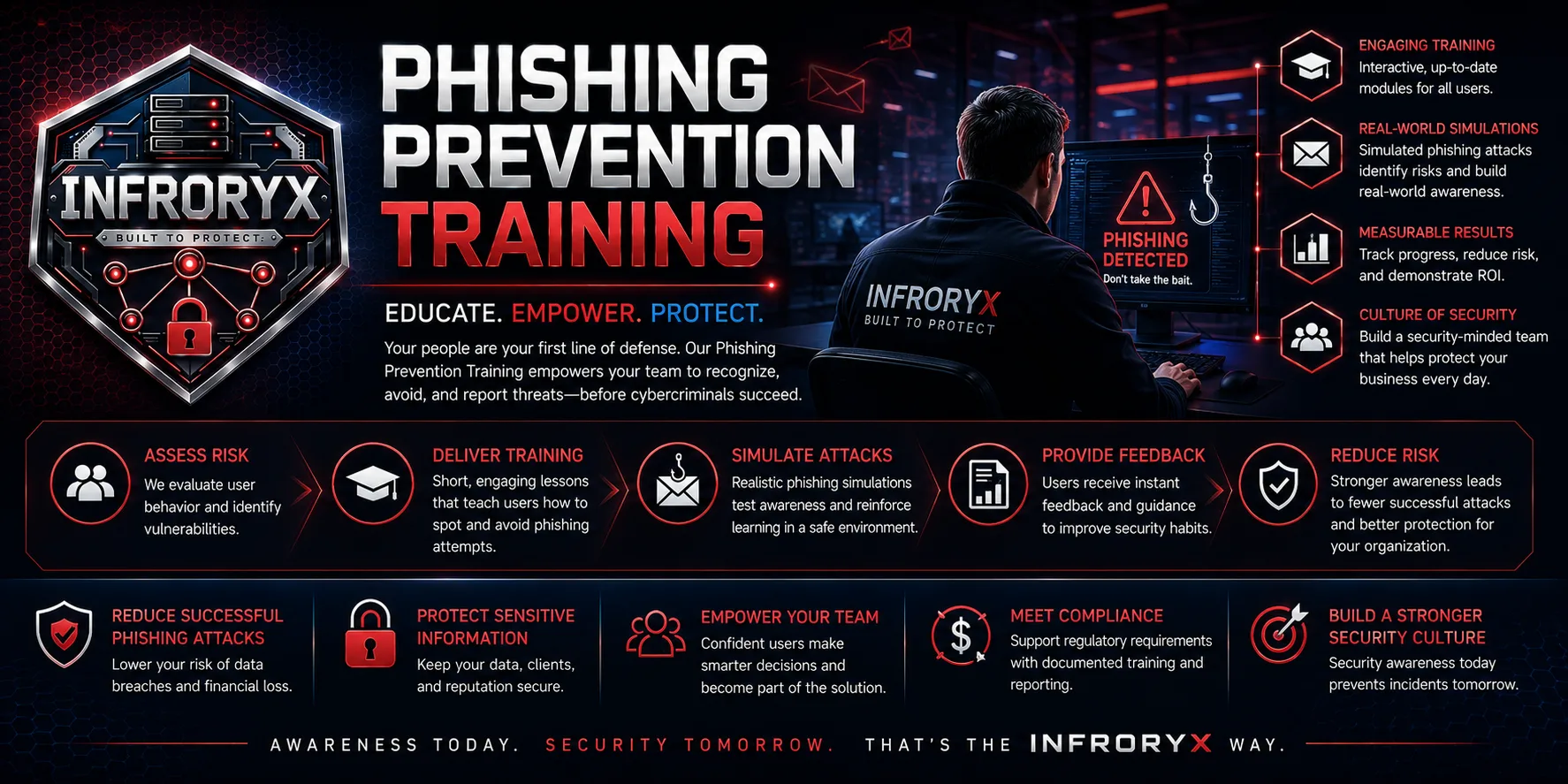
The Training Loop
Assess risk
User behavior evaluated and vulnerabilities identified.
Deliver training
Short, engaging lessons that teach users to spot and avoid phishing attempts.
Simulate attacks
Realistic phishing simulations test awareness and reinforce learning safely.
Provide feedback
Instant feedback and guidance that improve security habits.
Reduce risk
Stronger awareness leads to fewer successful attacks — and better protection.
How the Program Works
Infroryx provides managed anti-phishing training: an automated, 12-month campaign that steadily strengthens your employees’ ability to recognize, report, and block attempted phishing attacks.
The rhythm is what works: simulate, train, reinforce — continuously. Skills fade without practice, which is why an always-on program beats an annual seminar every time.
Simulations That Teach, Not Shame
Employees receive realistic — and completely safe — phishing simulations. A click becomes a teachable moment with immediate, short training instead of blame. The goal is a workforce that feels confident reporting suspicious messages, not one afraid of being caught.
Progress You Can Measure
Participation, click rates, and reporting behavior are tracked over the campaign, so you can watch susceptibility fall and vigilance rise — evidence of risk reduction you can show leadership, auditors, and insurers.
The Human Firewall, Layered
Trained people are one layer of defense-in-depth: pair the program with MFA so a slip doesn’t become a breach, and email security to thin the attacks before they arrive. Together, the layers cover each other’s gaps.
FAQ
Good Questions
Will employees feel tricked or embarrassed?
The program is deliberately constructive: simulations are safe practice, and a click leads to a brief lesson, not a callout. Teams quickly come to see it as a skill-builder.
How often do simulations run?
Continuously across the 12-month campaign — steady, varied, and automatic. Consistency is what builds lasting instincts.
Does training actually reduce risk?
Recognition is a skill, and skills improve with practice and fade without it. A continuous program builds the reflex to pause, verify, and report — which is exactly what stops real attacks.
Related
It All Works Better Together
Ready to close this gap? Let’s talk.
Every engagement starts with a free conversation about your environment and your risks — no prepackaged bundles, no obligation.